
The New Discipline in India's Real Estate Decision-Making
India's real estate sector is entering a new phase of maturity — one defined not by access to capital, but by the discipline with which capital is deployed.
According to JLL India, institutional investments in Indian real estate have consistently exceeded $6.5–7 billion annually in recent years, reflecting a market that is becoming increasingly data-driven, selective, and strategically aligned.
At the same time, Knight Frank estimates that India's ultra-high-net-worth population will grow by more than 50% by 2028, expanding the pool of sophisticated investors seeking structured and scalable real estate opportunities.
As capital becomes more abundant and investor sophistication deepens, the framework for real estate decision-making is evolving.
Market participation is no longer driven solely by opportunity recognition; it is increasingly shaped by clarity of strategy, quality of execution, and long-term value creation.
In this environment, strategic consulting and capital advisory have evolved from support functions into core drivers of investment performance.
Their role is no longer simply to facilitate transactions, but to bring structure, conviction, and alignment to increasingly complex real estate decisions.
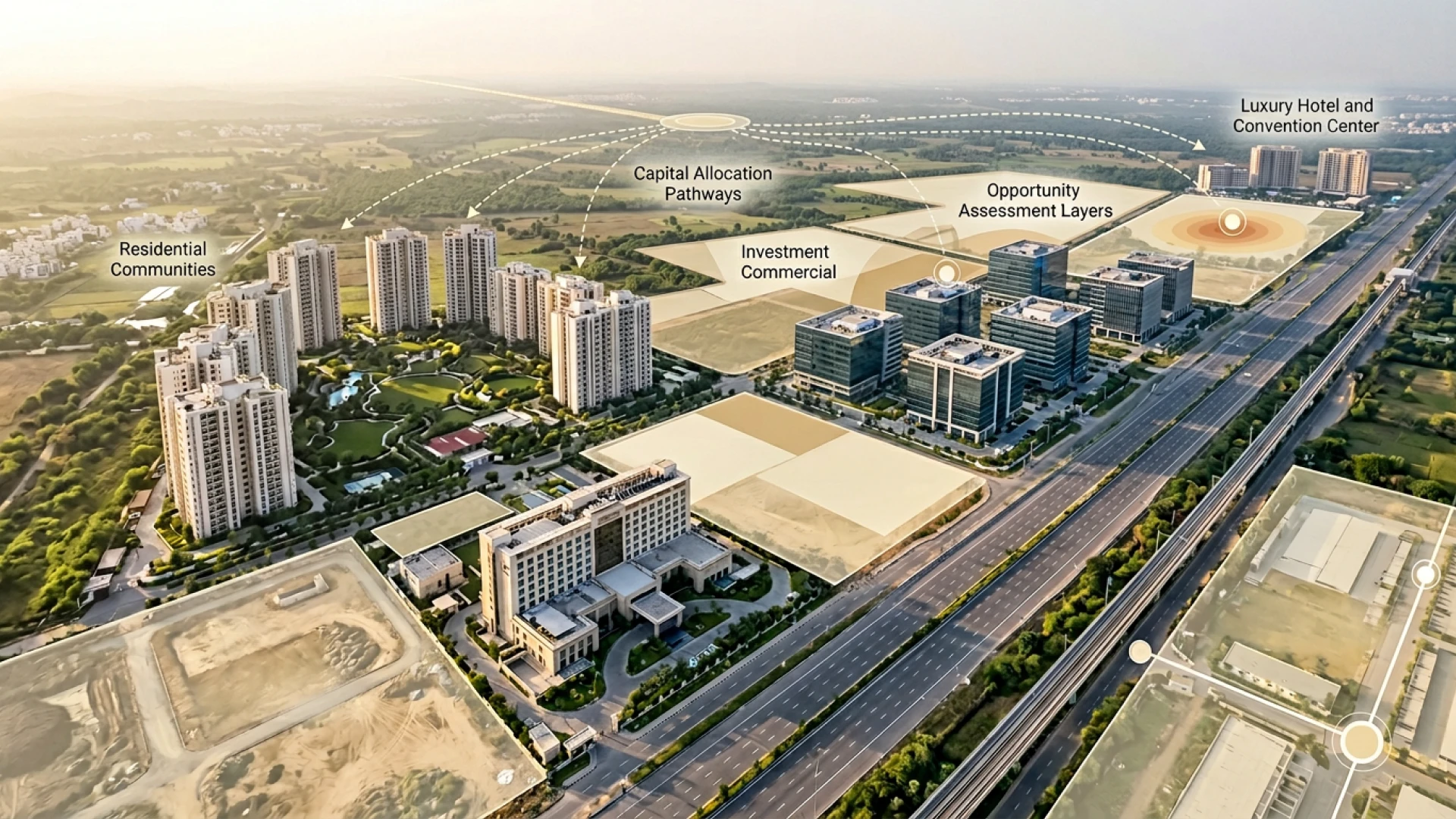
Abundant Capital, Limited Clarity: The New Market Paradox
India's expanding wealth landscape driven by IPOs, startup liquidity events, global capital flows, and generational transitions is reshaping how stakeholders approach real estate.
According to Prime Database, Indian corporates have repeatedly raised record capital through public markets in recent years, creating a new generation of financially literate investors.
Yet while capital availability has improved, decision complexity has multiplied.
Real estate today involves:
- Infrastructure-linked growth cycles
- Regulatory evolution
- Structured financing models
- Hospitality integration
- Exit and liquidity planning
For landowners, developers, NRIs, and institutions, the real challenge is no longer access to opportunity, it is filtering signals from noise.
Strategic advisory bridges that gap.

From Land Intelligence to Capital Structuring
Consulting in modern real estate must operate across the full lifecycle of an asset.
It begins with land intelligence evaluating title clarity, infrastructure pipelines, zoning dynamics, and demand viability.
According to industry estimates, land-related due diligence failures remain one of the largest hidden risks in emerging growth corridors.
Beyond land comes development feasibility absorption potential, ticket-size alignment, capital phasing, and positioning within broader market cycles.
Capital advisory then overlays structure onto strategy:
- Assessing capital requirements and phasing
- Aligning investor profiles with asset risk
- Designing entry and exit pathways
- Structuring stakeholder alignment
The objective is not simply to raise capital it is to ensure that capital is deployed where fundamentals justify it.
Disciplined advisory reduces volatility and enhances long-term performance.

Beyond Transactions: The Shift to Lifecycle-Driven Advisory
Traditionally, advisory in Indian real estate has been transaction-led. However, global markets show a shift toward lifecycle-driven consulting models.
In mature markets such as the US and UK, advisory firms increasingly remain engaged beyond acquisition advising on repositioning, refinancing, operational optimisation, and structured exits. India is moving in the same direction.
Modern stakeholders require support at multiple stages:
- Early-stage feasibility
- Development strategy calibration
- Capital restructuring
- Sales alignment
- Exit and liquidity planning
The value lies in continuity. Real estate is rarely a one-decision asset class; it is a sequence of strategic decisions over time.
Advice that adapts across cycles becomes a strategic asset in itself.

Risk Mitigation as the New Value Driver
As markets mature, return optimization alone is insufficient. Risk mitigation has become equally important.
Institutional capital increasingly demands:
- Demand validation before scale
- Infrastructure-led positioning
- Structured governance
- Transparent reporting
- Clear exit pathways
According to global real estate advisory trends, assets with strong fundamentals and transparent capital structuring tend to attract higher-quality investors and demonstrate more stable pricing resilience during market corrections.
In India's evolving second-home and hospitality corridors, particularly infrastructure-driven zones this discipline becomes even more critical.
Advisory must therefore integrate:
- Demand intelligence
- Development alignment
- Capital prudence
- Exit visibility
Without this integration, capital exposure increases.
Technology Enables Insight, But Strategy Requires Judgement
The rise of proptech and digital analytics has improved data accessibility. India's proptech sector is projected to grow significantly over the next decade, reflecting increasing digital integration across real estate.
However, technology alone does not eliminate risk.
High-stakes real estate decisions still require:
- Local market intuition
- Negotiation acumen
- Regulatory understanding
- Stakeholder alignment
- Timing judgement
Algorithms enhance insight, but credibility and experience anchor confidence.
The most effective advisory models combine data intelligence with human strategy.
A More Disciplined Real Estate Era
India's real estate ecosystem is gradually shifting from speculative velocity to structured growth. Infrastructure-led corridors, hospitality integration, and rising capital sophistication are pushing the market toward greater maturity.
In such an environment, consulting and capital advisory are no longer peripheral services. They are structural enablers.
The next phase of Indian real estate will likely reward:
- Disciplined land selection
- Phased capital deployment
- Demand-validated development
- Transparent governance
- Exit-aware planning
For stakeholders navigating this landscape, the differentiator will not be access to opportunity but the ability to evaluate, structure, and time that opportunity correctly.
Strategic consulting and capital advisory transform complexity into conviction.
And in an increasingly capital-rich yet information-dense market, conviction is the most valuable currency of all.